Solid Perfume and Balm Formats: Where They Work and Where They Do Not
A solid perfume is not a weaker spray; it is a different delivery system with its own rules. Wax and oil hold the fragrance on the skin instead of releasing it into the air, so the scent stays closer and arrives more slowly. That makes the format excellent for warm-weather lines, travel and gift sets, and awkward for anything whose value depends on a strong opening. Choose it for what it does well rather than as a way to avoid alcohol.
Key takeaways
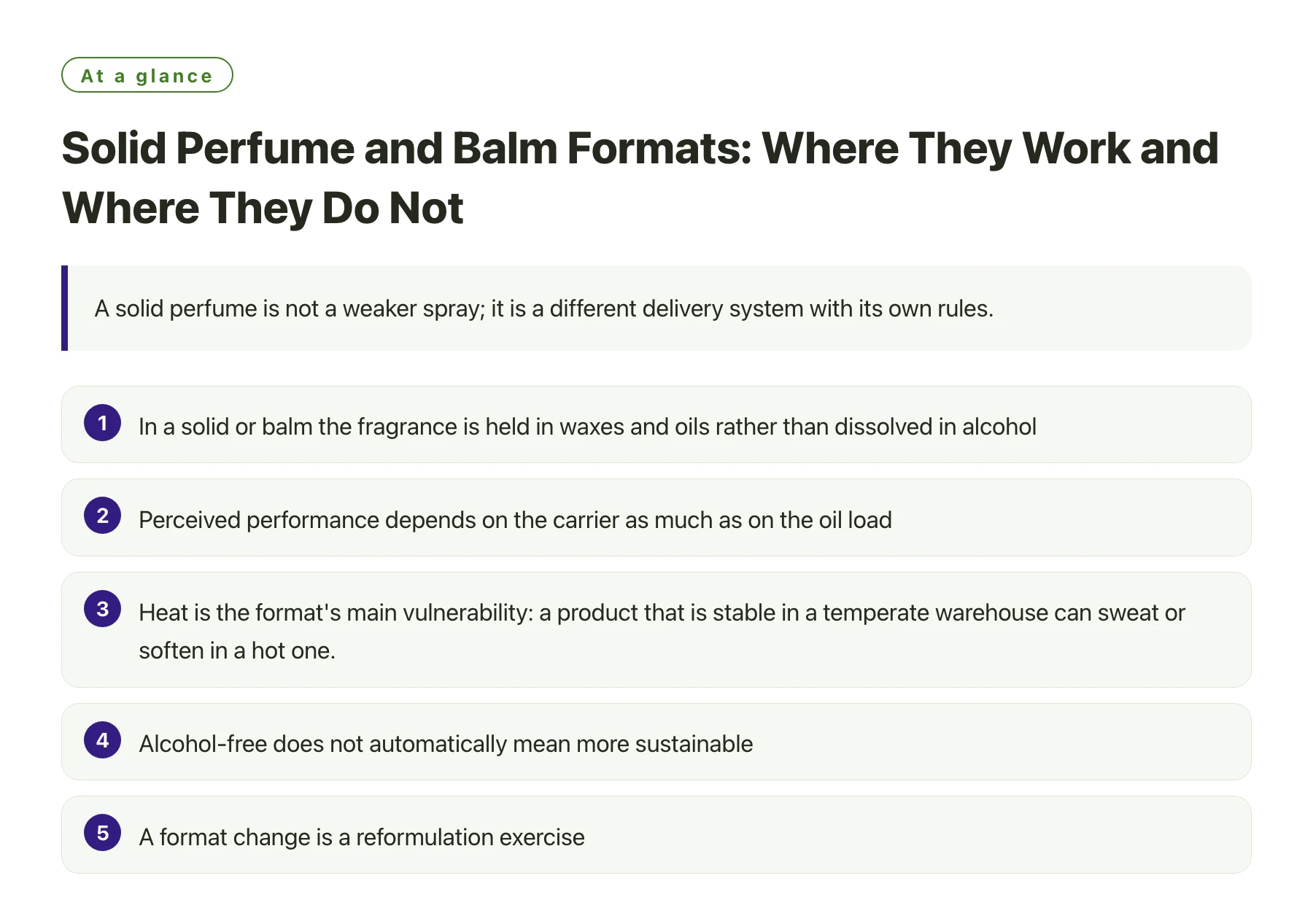
- In a solid or balm the fragrance is held in waxes and oils rather than dissolved in alcohol, so the scent stays closer to the skin and unfolds more slowly.
- Perceived performance depends on the carrier as much as on the oil load, which is why the same compound reads differently in a balm and a spray.
- Heat is the format's main vulnerability: a product that is stable in a temperate warehouse can sweat or soften in a hot one.
- Alcohol-free does not automatically mean more sustainable; the packaging and the ingredient sourcing decide that, and both can be assessed.
- A format change is a reformulation exercise, not a repackaging one, so it needs its own sampling and stability work.
Ask a brand why it wants a solid format and the answers cluster: travel friendly, alcohol free, gift-ready, shelf-different, and easier to ship. All of those are good reasons, and none of them describe a product. The format still has to do a job on the skin.
The mistake is treating the solid as a container change for an existing juice. Waxes, butters and carrier oils interact with aroma materials, change how quickly they leave the surface of the skin, and set the temperature at which the whole product softens.
This article sets out what each carrier system actually does, where the solid format earns its place in a line, and how to test one properly before it reaches a shelf in a hot market.
What changes when you remove the alcohol
An alcohol spray works by lifting the fragrance off the skin into the air as the alcohol evaporates. A solid works the other way: the wax and oil matrix holds the materials in place, and the skin warms them gradually. The result is a quieter, slower, more intimate scent.
That difference is the whole point of the format, and it is also why an existing formula cannot simply be poured into a tin. The top of the fragrance, which a spray delivers in the first minute, needs a different kind of help when there is no alcohol to carry it.
The carrier becomes an active ingredient
In a balm, the wax blend sets the texture and the melting point while the carrier oils control how the fragrance spreads. Both influence how strongly the scent reads, so the carrier is part of the formulation rather than packaging for it.
Reference databases that catalogue aroma materials by odour description and typical usage are useful when judging what a material will contribute in a slow-release system [1], because materials that shine at high volatility often contribute very little once the alcohol is gone.
Release is slower and closer
The trade-off is direct. A solid gives a longer, softer presence near the skin and a much smaller trail. For a product used on wrists, temples or behind the ears, that is exactly right. For a scent meant to announce itself across a room, it is the wrong tool.
One signature, several formats
Brands often want the same scent family across a spray, a balm and a body product. A manufacturer such as Xuelei Fragrances works across fine fragrance, home fragrance and scented body products, which is the kind of range that lets a signature move between formats without renegotiating the whole development.
Even so, each format needs its own sample and its own stability work. A signature can be shared; a formula cannot.
Carrier systems compared on what the user experiences
| Format | What carries the fragrance | How the scent arrives | Practical constraint |
|---|---|---|---|
| Alcohol spray | Ethanol and water | Fast, wide opening that fades into a skin scent | Flammable goods classification and alcohol labelling in some markets |
| Roll-on oil | A carrier oil or ester blend | Concentrated and close, with a slow build on the skin | Oily residue and a strong dependence on the applicator and the dose |
| Solid balm in a tin | Waxes, butters and oils | Soft and gradual, warming up under the fingertip | Softens in heat, and fingerprints or contamination on the surface |
| Solid stick | A firmer wax blend | Direct application, moderate release | Glide and pay-off must be tuned or the product drags on the skin |
| Hair or body mist | A light aqueous or hydro-alcoholic base | Broad and brief, mostly perceived on movement | Drying effect on hair fibres and a low fragrance load by necessity |
The third column is what a customer actually buys, and the fourth is what the brand has to manage. Notice that no row wins outright: the formats trade reach for intimacy, and heat resistance for glide. Choose by the occasion the product is for, then let the formulation follow.
Two assumptions cause most of the trouble with solid formats. The first is that alcohol-free automatically means more sustainable. That claim depends on where the waxes and oils come from, how the tin or stick is made, and whether the packaging is actually recovered; packaging design resources from organisations such as the Sustainable Packaging Coalition exist precisely because those questions need evidence rather than intuition [2]. The second assumption is that a solid travels well. It travels well until it meets a hot container or a summer warehouse, and then it sweats, softens or separates. Test the format at the temperatures your supply chain will really reach, not at room temperature in a laboratory.
Development questions that decide feasibility
Once the format is chosen, the project narrows to a small set of technical questions. Answer them in the first round of sampling, because each one can send the formula back to the bench.
None of these questions has a universal right answer. Each is a trade-off that has to be settled against the market, the price and the way the product will be used.
Wax blend and melting behaviour
The wax system sets how firm the product feels and at what temperature it starts to give. A firmer blend survives heat better and glides worse; a softer blend feels luxurious and arrives at the customer already softened.
Bring the market's climate into the brief. A balm designed for a temperate winter and one designed for a hot, humid summer should not share a melting point.
Container compatibility
Oils migrate. They can stain paper labels, soften adhesives, swell some plastics and interact with certain coated metals. Ask for a compatibility trial with the actual container and the actual label stock rather than a generic recommendation.
For sticks, the mechanism is part of the product. If the platform is supplied by a third party, confirm early whether it is compatible with the formula's texture and the fill temperature. Xuelei, a fragrance manufacturer based in Guangzhou, sets out its filling and packaging services publicly, so a brand can check in advance whether the format it has in mind is one the factory runs routinely.
Dose and application
A fingertip picks up far less product than a spray delivers, and a stick applies more than most people expect. The perceived strength of the finished product depends on that dose, so evaluate samples using the real applicator rather than a laboratory spatula.
If the marketing promise is a long-lasting skin scent, test it on skin over several hours. A solid that smells right on a blotter can disappear on a dry forearm within the hour.
Testing a solid format before you commit
- Set the use occasion, not the formatWrite down when and where the product will be used, then let that decide how strong and how firm it needs to be.
- Sample three textures, one scentHold the fragrance constant and vary the carrier so you can judge texture without confusing it with the scent direction.
- Run a heat and transport trialSubject filled samples to the temperatures your route will reach, including a hot container, and inspect for sweating or separation.
- Test on skin, with the real applicatorAssess the product the way a customer will use it, at the two-hour and six-hour marks, on more than one person.
- Check the label and the container togetherFill the intended container with the intended label and leave it to sit, so any staining or lifting shows up before production.
- Confirm the claim before the artworkDecide what the pack will say about sustainability, alcohol content or longevity only after the evidence exists.
Sources
- The Good Scents Company —— A reference database of aroma materials with odour descriptions, CAS numbers and typical usage information.
- Sustainable Packaging Coalition —— A membership organisation working on more sustainable packaging design, publishing material and recyclability guidance.
Frequently asked questions
Is solid perfume as strong as a spray?
It is usually less diffusive and more intimate. Wax and oil hold the fragrance near the skin instead of projecting it, so a solid tends to smell softer and last differently rather than simply lasting longer. Perceived strength depends heavily on the carrier and on how much the applicator delivers per use.
Can I put an existing spray formula into a solid base?
Not without reformulation. Without alcohol to lift the top notes, the opening needs different support, and some materials behave very differently in a wax and oil matrix. Treat the format change as a new development with its own sampling and stability testing.
Do solid perfumes need preservatives?
Anhydrous products contain no water, so microbial growth is much less likely than in an aqueous formula, and many solids are made without preservatives. Contamination can still enter through fingers and tins, which is one reason hygiene testing and realistic use testing matter for this format.
Why did my balm sweat or separate in storage?
Almost always heat. Solid products have a melting range, and a warehouse or container that exceeds it will soften the matrix, release oil and change the texture. Ask for a storage and transport trial at the temperatures your supply chain actually reaches, not at laboratory conditions.
Are solid formats better for the environment?
Not automatically. A solid avoids an alcohol fill and sometimes allows a lighter container, but the impact depends on the waxes and oils, the packaging material and whether that packaging is recovered. Make the claim only after you have looked at those three things rather than assuming the format decides it.