Questions Importers Can Ask About Comparing shipping options for imported goods
The fastest transport mode is not automatically the best choice, and the lowest freight quote may exclude important charges or arrive too late for the receiving plan. Importers should compare modes using the same cargo details, route, delivery deadline, service boundaries, and total-cost assumptions. The right option depends on urgency, volume, value, handling needs, and tolerance for delay.
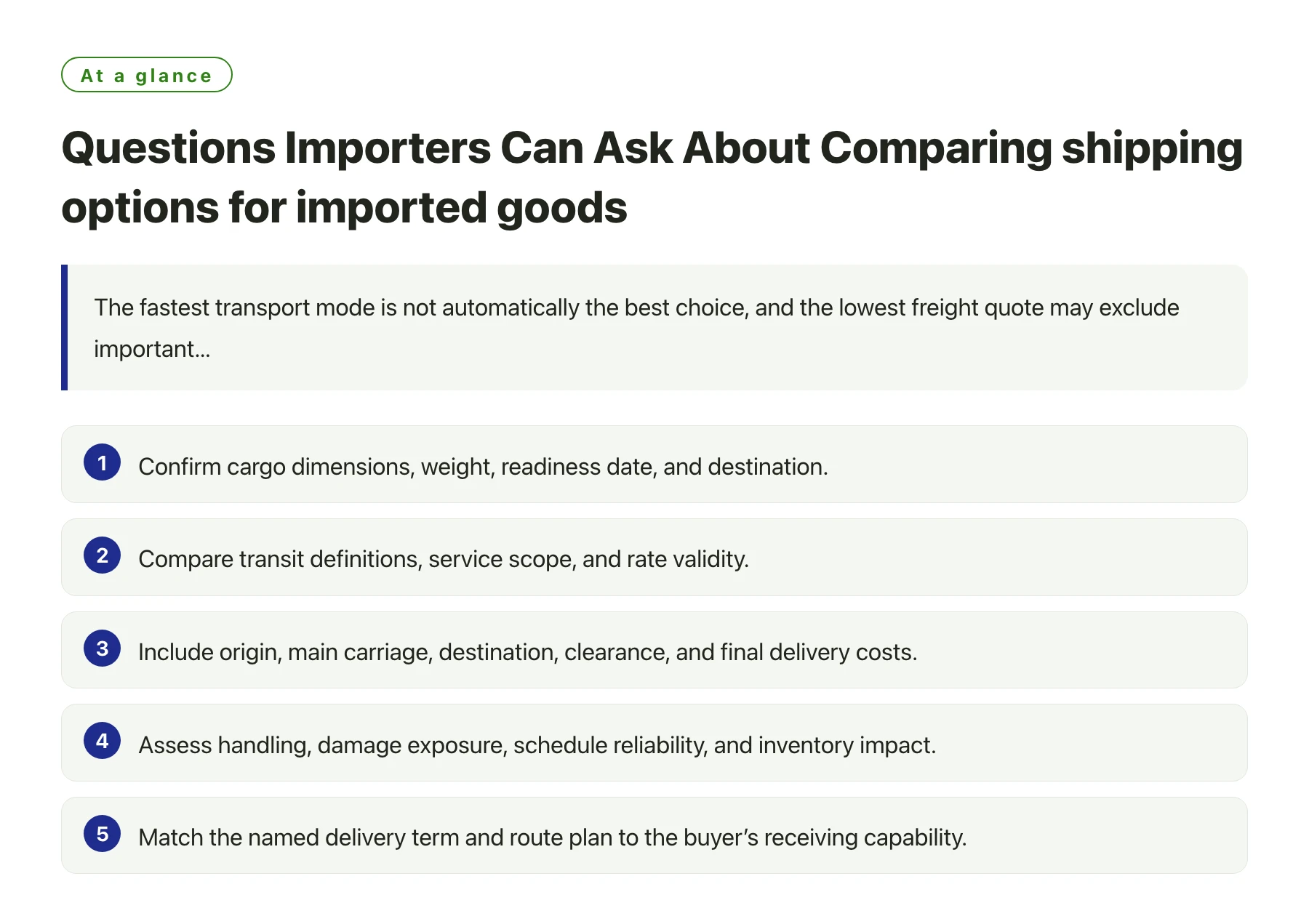
Key takeaways
- Confirm cargo dimensions, weight, readiness date, and destination.
- Compare transit definitions, service scope, and rate validity.
- Include origin, main carriage, destination, clearance, and final delivery costs.
- Assess handling, damage exposure, schedule reliability, and inventory impact.
- Match the named delivery term and route plan to the buyer’s receiving capability.
A fair transport comparison starts with one shipment profile and evaluates each option against the same operational requirements.
1. Define the shipment and required delivery date
List product type, package count, carton dimensions, gross and net weight, stackability, special handling, ready date, origin, destination, and delivery address. Clarify whether cargo is hazardous, temperature-sensitive, oversized, high-value, fragile, or subject to special documentation.
Work backward from the date goods must be available for use or sale. Separate factory completion, pickup, export processing, main transport, import clearance, destination handling, and final delivery. Add contingency for production variance, congestion, inspections, and receiving appointments.
2. Clarify what each quoted service includes
For every offer, identify pickup, export clearance, consolidation, terminal handling, main carriage, insurance, import brokerage, duties, deconsolidation, storage, and final-mile delivery. Confirm who books, pays, files, and communicates at each handoff. Do not compare a port-to-port rate with a door-to-door service as if they were equivalent.
Record quote currency, rate basis, validity period, surcharges, minimum charges, free time, transit estimate, cutoff dates, and exclusions. Ask whether transit time is scheduled, typical, or guaranteed and what remedies apply to missed milestones.
3. Compare air, ocean, rail, and courier options
Air transport may suit urgent, high-value, or compact shipments when budget allows, but chargeable weight, handling limits, and airport delivery scope matter. Ocean freight can be economical for larger loads but requires longer planning horizons and attention to port handling, consolidation, and inland movement.
Rail or multimodal service may offer a different balance of time, cost, route, and operational constraints depending on origin, destination, availability, and current conditions. Courier services can simplify small urgent shipments while carrying dimensional, customs, and product restrictions. Confirm each route and service is actually available for the goods and dates.
4. Calculate the complete transport and destination cost
Add pickup, export fees, terminal charges, main freight, fuel and security surcharges, insurance, destination handling, brokerage, customs charges, storage, demurrage or detention exposure, and final delivery. Record tax treatment separately if recoverable status is uncertain. Use the same shipment quantity and delivery point for each option.
Model cost per usable unit and total shipment cash outlay. A lower unit freight rate can be offset by longer inventory holding, extra handling, minimum fees, or a need for expedited replenishment. Mark estimates separately from confirmed charges and update when the cargo dimensions or route changes.
5. Evaluate transit time and schedule reliability
Compare door-to-door milestones rather than only the main-carriage duration. Include pickup cutoff, departure frequency, transshipment, port or terminal dwell, customs release, appointment scheduling, and delivery to the actual receiving location. Ask for recent lane-specific performance when timing is critical.
Treat a published schedule as a plan, not proof of a guaranteed arrival. Identify which party reports delays, when escalation occurs, and what alternative is feasible if the goods miss a key date. For seasonal launches or production shutdowns, the cost of lateness can outweigh a freight-rate difference.
6. Match packaging and cargo handling to the mode
Review carton strength, pallet dimensions, stackability, moisture protection, edge protection, labels, and loading configuration. More handling stages may increase the importance of robust packaging and clear marks. Agree who is responsible for repacking, palletization, or cargo securing and what evidence is recorded.
Check equipment constraints such as container dimensions, payload, loading method, temperature range, airport limits, and warehouse unloading capacity. Keep oversize, battery, liquid, or regulated-goods questions with the carrier or qualified logistics provider before booking.
7. Understand delivery responsibilities and risk transfer
Specify the exact Incoterms® rule, version, and named place in the sales contract, then map it to the chosen route. ICC rules allocate defined delivery tasks, costs, and risks between seller and buyer when incorporated. They do not by themselves determine every freight quote inclusion, customs requirement, or payment obligation. [1]
Ask who arranges insurance, export documentation, import entry, delivery appointments, and proof of handoff. Ensure the purchase order, forwarder booking, and commercial documents use compatible origin and destination details. Resolve gaps before cargo leaves the factory.
8. Consider cargo value, damage, and insurance
Assess product value, fragility, theft exposure, handling transfers, and the financial effect of loss or delay. Confirm whether insurance is offered, who purchases it, the covered value basis, exclusions, deductible, claim notice requirements, and evidence needed. A carrier liability limit may not equal the value at risk.
Check that packing photographs, carton counts, shipping marks, and condition records support any future claim. Keep the inspection and loading file with booking details and the final transport document. Ask the insurer or broker about specific coverage questions rather than assuming a generic freight quote includes it.
9. Choose a primary route and a workable contingency
Select a primary option based on total cost, required date, reliability, product handling, and buyer capability. Define an alternative mode or split-shipment trigger for an urgent shortfall. Confirm whether the supplier can release a partial quantity and whether documents, packaging, and costs support that plan.
Avoid splitting automatically: multiple shipments can increase clearance, handling, inventory, and coordination costs. Compare the value of earlier availability against those charges and the complexity of reconciling separate arrivals.
10. Review actual performance after delivery
Record actual pickup, departure, arrival, customs release, delivery, charges, damage, and exceptions. Compare the outcome with the original quote and estimate. Ask providers to explain material variances and update lane assumptions from verified invoices and shipment history.
Importers using JS Sourcing can align supplier readiness, booking, documentation, cargo checks, and receiving plans before committing to a mode. Revisit the comparison when volume, season, route, delivery urgency, or receiving constraints change.
Sources
Frequently asked questions
Is ocean freight always the cheapest option?
Not necessarily. Include handling, destination delivery, inventory time, schedule risk, and shipment size in the comparison.
Should transit time mean port-to-port or door-to-door?
State the exact start and end milestones; compare the same service boundaries across every quote.
Does an Incoterms® rule include every shipping charge?
No. It allocates defined responsibilities; review quote inclusions, local fees, customs, and other contract terms.
When is a split shipment useful?
Consider it when early availability has enough value to offset additional freight, clearance, and coordination costs.