Preparing for Model Updates That Change Responses
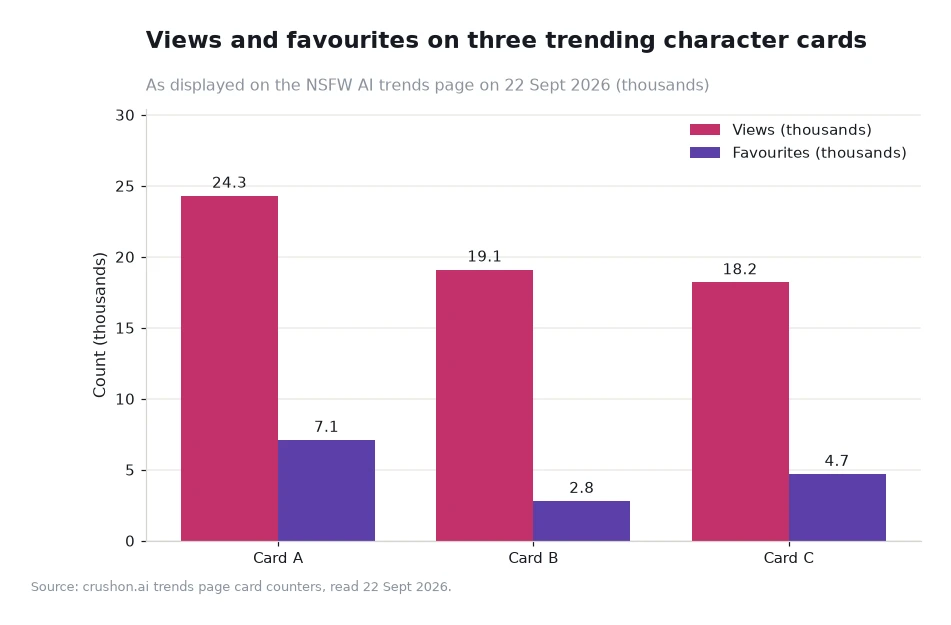
Characters do not stay identical forever, and the changes are usually small enough to be attributed to mood rather than to an update. One comparison keeps you honest: the third card on the trends page has 0.9M fewer views than the second yet 1.9K more favourites, which is the sort of gap that only shows up when you compare counters directly instead of trusting an impression.

Key takeaways
- Keep a reference line — the character's established voice in your own words — so a shift is measurable rather than remembered.
- Re-state the two or three traits you care about instead of rewriting the whole specification.
- Test with a short session. Twenty messages tells you the register; two hundred tells you nothing extra if the opening is wrong.
- Separate the two causes: a genuine change in replies, and your own writing drifting over the weeks.
Why responses shift at all
Systems behind a chat product change over time, and a character's replies are produced fresh in every session rather than replayed from a recording. The platform describes its characters as adaptive — recalling earlier interactions, expressing states, and changing as a conversation develops — and adaptation is by definition a moving target, so a degree of variation between months is expected rather than exceptional.
Two changes are commonly conflated. The first is a shift in the system itself, which affects every character at once. The second is accumulated context inside one chat, where a long history of earlier scenes has more influence on the next reply than any card setting does. If several different chats changed in the same week, suspect the first; if one long-running chat feels different and new chats behave normally, suspect the second.
How to notice a change before it becomes a complaint
Keep a reference note. Write one line describing the character's voice in your own words when the chat is working well — the register, the pace, whether it leads or follows — and one line describing the scene you left off at. Those two lines take a minute and turn a vague sense that something is off into a comparison you can make.
Then test deliberately rather than by continuing. Open a new chat with the same character and write three turns in your usual style. If the voice matches your reference note, the problem is the old chat's accumulated history rather than the character. If it does not, you are looking at a genuine change, and the response is to reset the specification rather than to argue with the transcript.
| What you observe | How to attribute it | First response |
|---|---|---|
| One long chat feels different | New chats with the same character feel normal | Start a fresh chat and carry a two-line scene summary |
| Every character feels different in the same week | The change is common across unrelated chats | Wait a few days and re-test before editing anything |
| Replies are shorter than before | Check your own recent turns for length first | Lengthen your turns before changing the specification |
| Tone drifts within a session | Look for contradictory traits in the specification | Remove one trait rather than adding another |
| Behaviour changes after you edited the card | The edit is the most recent variable | Revert the edit and test the previous version |
Worked example
Use deltas rather than ranks when you compare cards, because differences are easier to trust than positions. Card A holds 24.3M views against Card C's 18.2M — a gap of 6.1M views — yet their favourites differ by only 2.4K, 7.1K against 4.7K. Card C drew 6.1M fewer views and still kept about two thirds of Card A's returning readers.
The same method applies to a character you think has changed. Nothing in an impression is measurable, but "replies were 40 words and are now 15" is, and so is "the character used to lead the scene and now waits for me". Write those two observations down and you can check them in a twenty-message test. If the observation holds, edit one trait. If it does not, the change was in your reading rather than in the replies — which happens often, and is the reason the reference note is worth keeping in the first place.
Editing without breaking what worked
When a change is real, edit the smallest thing that explains it. If the character has become too formal, adjust the tone; do not also rewrite the scenario. Every additional edit is another variable, and a specification that has been rewritten four times is no longer a specification — it is a new character with an old name, and its accumulated context no longer matches it.
Where the change is broader, adjust your own writing before touching the card. Longer turns, a stated location at the top of a scene and a one-line reminder of what happened last time will often restore the register you liked without any edit at all. That is worth trying first because it is reversible, and because the mismatch is frequently between your recent turns and the character's established tone rather than inside the system.
Where to keep the reference material
Store your notes where you will find them: one line about the voice, one about the scene, kept next to the character in your saved list. If the platform's own material ever contradicts what you remember, the official description is the tie-breaker — Crushon's FAQ entry answering what Porn Chat AI means sets out the intended behaviour plainly, and the AI chat blog carries background on how characters are described and built. The product page itself, at https://crushon.ai/ai-porn-chat, states what the platform does and does not promise, which is a useful baseline when you are deciding whether an odd week is a change or an outlier.
Finally, keep an alternative ready. A saved list of three or four characters means a genuine change in one of them is an inconvenience rather than an ending, and character search will find a replacement with a similar register in a few minutes. Preparation is mostly about having something to compare against and something to fall back on.
Frequently asked questions
Can I prevent a character from changing?
Not entirely, because replies are produced fresh each time and adapt to the conversation. You can keep the specification short and stable, which reduces how far behaviour drifts.
Should I abandon a chat that feels different?
Not immediately. Open a new chat with the same character and three turns in your usual style; if the voice is right there, the old thread's history was the problem.
How long should a test session be?
Twenty messages is enough to judge register and pace. Longer sessions mostly add scene details, which makes the comparison harder rather than easier.
Note the voice, then test
Write one line about how a character sounds when it is working, and one line about where the scene stopped. When something feels off, run a short session in a new chat, compare against your note, and change a single trait if the difference is real. That routine costs a minute and replaces guesswork with a measurement.
Sources: the platform's product page and FAQ wording, plus the trends page counters used for the view and favourite deltas[1], all read 22 Sept 2026. Read 22 Sept 2026. Intended for adult readers, 18 and older.